Wednesday, June 26, 2019

My Problems with Interstellar Act 2

I'm not a fan of wormholes as a transportation device. With all due respect to Dr. Kip Thorne, in reality they make a terrible medium for travel.

First, wormholes are possible in theory. However, there is no empirical evidence to prove they actually exist, but the math suggests they do. Einstein was the first to propose the existence of wormholes, and he's been right so often with his theories that it's hard to believe he would be wrong. The difficulties come with how they are created, and it tells you a lot about the kinds of forces you are dealing with. It's these forces which cause the problem with traveling through a wormhole, and not the existence of the phenomenon.

Wormholes are accurately explained in the movie. They describe what a wormhole does, and what it looks like. The problem is not the phenomenon itself. The problem comes with how they are crated. Einstein and Hawking both wrote about wormholes. Einstein posited that if a mass were to be dense enough, it could cause a highly localized distortion in space-time. This distortion could form a hole in space-time causing it to fold space from one point to another. Hawking proposed, and has since modified, a theory that the wormholes form their own pocket universes. In either case, wormholes require a huge mass that has compressed to the point where it rips a hole in space-time.
NASA JPL actual black hole

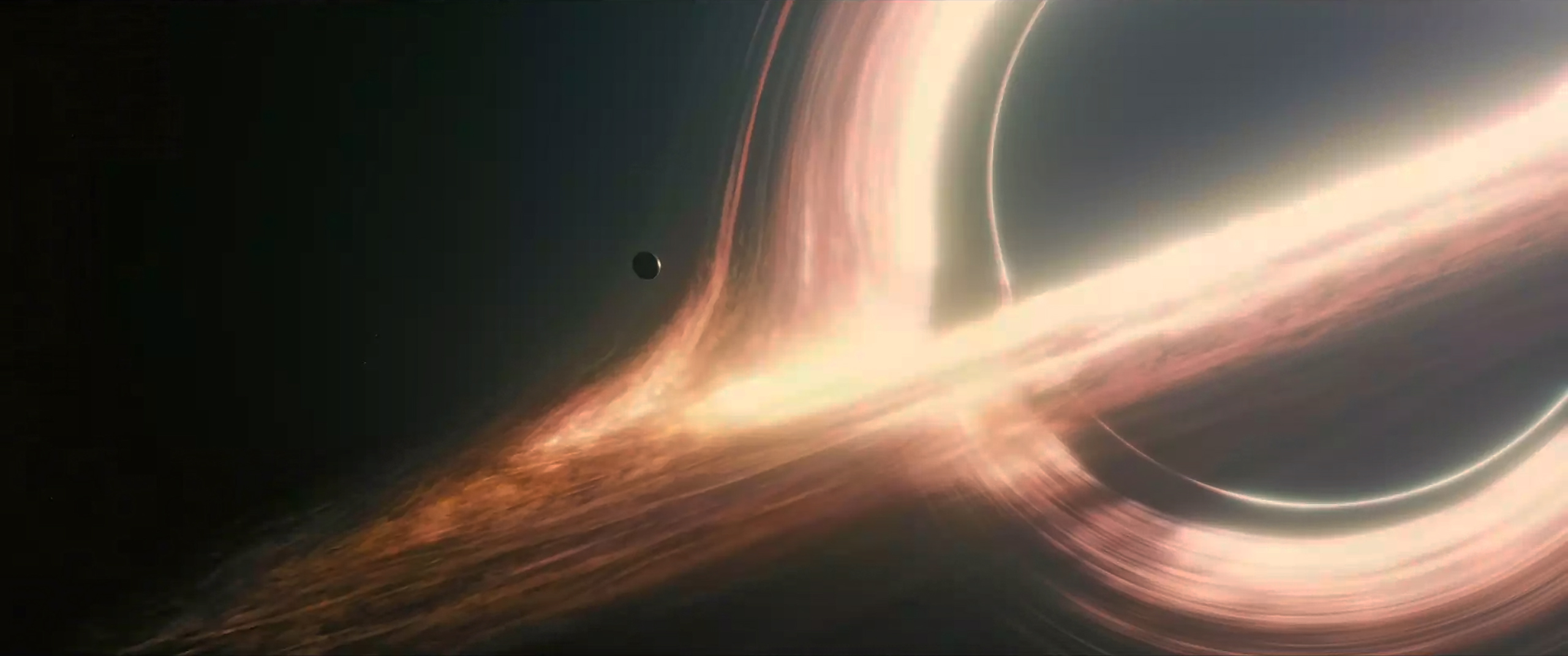
black hole from Interstellar Movie
Black holes are massive and dense enough they can rip holes in space-time. We know they exist, and have even photographed them, and they look fairly close to what we thought they would.  The forces on the ship and crew is a major problem that would prohibit traveling through space.

The next issue confronting the progression of the plot is the Plan B contingency. Plan B is the use of In Vitro Fertilization (IVF) to repopulate a habitable planet. This would occur if the crew was unable to return to Earth, or the people on Earth were unable to evacuate the planet. My issue is not the technology, or the idea, but how it's carried out.

The idea would be for Anne Hathaway's character, Dr. Brand, to act as surrogate for the embryos, and become a surrogate Eve on the new world. Obviously, this plan was concocted by someone who has never been a parent, or given birth. There is almost a metric ton of frozen embryos for use in this plan. I wondered if the plan was for her to give birth to them all, because that seems to be putting a lot of eggs in one basket.

This entire plan is designed to fail. Why?

Because, Dr Brand is the ONLY female on the mission. The mission starts with three males, and ONE (singular) female. The back-up plan is for her to use IVF to get pregnant (a lot), and hope that she doesn't die giving birth. There is no fail-safe measure. There are no other women on the ship, and (wish all you want) men can't have babies (even with IVF).

By the end of the film (SPOILER ALERT), she's left alone. How many women would be willing to:

1. Live on an alien world - ALONE
2. Have a child - ALONE
3. Raise said child - ALONE

All of this while scratching out an existence on a world with unknown hazards and hardships (need I repeat it - ALONE!). This would NEVER work as a plan.

You might be thinking: "This writer is an idiot. He doesn't know how strong women are. He must be some misogynist jerk who doesn't give Dr. Brand the credit she deserves."

You would be wrong. I am married to a strong woman. She raised two of her own children, and many of her siblings by herself. My mother, and sisters are all strong women. My great-grandmother raised a whole bunch of kids by herself in an unforgiving mountain valley in Idaho. I know strong women. I know what mentality it takes. I know that there comes a point where, if living becomes too much of a challenge, people can't continue. No matter how strong they are.

Pioneering a new world would be challenging enough, but raising an entire civilization by yourself would break Dr. Brand. I base this on her reaction after she makes a bad decision, and gets one of the crew killed.


The simple problem comes to this: There are far too few crew, and not enough women to complete the secondary mission if the primary one fails. For a science heavy story, it fails basic math.

Act 3 soon to come.

Sunday, June 9, 2019

My Problems with Interstellar Act 1

I like Christopher Nolan's work. He is a thoughtful director and writer. I actually LIKE Interstellar, HOWEVER, for a film that concentrates so heavily on the science, this one falls through plot holes the size of Gargantua.

First, let's look at the premise which starts our protagonist on his hero's journey. Earth is doomed to run out of food due to a nitrogen loving blight. The last crop is corn. Wars are finished, because people can't feed the armies needed to fight them. Technology is shunned, because we need food not television. NASA has gone underground because of the proliferation of anti-scientific propaganda. The only person who can save us all is a pilot/engineer who has turned to farming because... reasons. Yet, this farmer is the only one who can fix combines which still use a functioning GPS constellation to till the fields between dust storms. SIGH!

Let's start with the idea that technology is bad. At the same time, vehicles are still used, power is still on, and somehow there are satellites in orbit. All of those things require technological infrastructure to build and maintain. Satellites are not autonomous. They require a ground control station. Power generation is also something that requires constant maintenance and control. Vehicles require fuel (There was no way that dual axle truck was electric), and that requires a refinery and petroleum well. All of that has to be maintained by mechanics and engineers, so the farmers can do their job. The idea that everyone needs to become farmers instead of scientists, mathematicians, and engineers has been tried (Cambodia), and it didn't work out so well.

If we were reduced to okra and corn, we would be in horrible shape. Ask the Irish how well an agrarian society that depends on a single crop does if there's a disease that kills plants en mass. It would mean that rice, wheat, beans, fruit trees, root vegetables (onions and carrots), leafy vegetables (cabbage and lettuce), and other edible plants had all died. The animals that relied on all those plants would be dead. All the other inedible which the animals had eaten would be dead. All the insects that had relied on those plants would be dead. All the marine life would also be dead. In other words, we would have died long before corn was the only plant that survived. I can't tell if Mr. Nolan was trying to make a statement about how America loves corn, but it's a terrible crop to grow. Corn depletes nitrogen, uses tons of fertilizer, pesticides, water, and contributes to soil erosion. Almost any other plant would be a better crop.

Suspension of disbelief is required for science fiction. If you can't get past the initial conditions, it makes it more difficult to believe the events which serve to set up the first "pinch" (event that sets up Act 2). Why is leaving Earth a better option than trying to SAVE it. This makes the assumption that another planet will be found which will support life as we know it. Earth is the ONLY planet we have found which can support life.
It's not too hot.
It's not too cold.
It has abundant water.
It has a robust magnetic field.
It has a thick atmosphere.
There is abundant oxygen in the atmosphere.
The Earth is not too large, or too small.
The sun is not too active.
The sun is relatively stable.
The sun is not too large or too small.
This is not to say that the Earth is so unique that it's the only world that supports life.
It is not.
I believe that other planets, similar to Earth, exist. They just aren't as common as people wish they were. With the vast distances between worlds, and the great distances involved, we can NEVER take our home for granted. We are stewards, not owners, lords, or masters of this world. We need to care for what we are given.

Which leads me to my last point.

What makes the characters of the film think they will be able to alter the views of civilization enough to prevent a repeat of the mistakes of the past? What makes the astronauts think they won't take the contamination (blight) with them to another world, and wreck that ecosystem as well? How would you prevent someone from propagating the destructive ideas and policies in a new world? What happens if the only habitable planet you find, already has inhabitants? How do you keep from destroying the place you colonize? None of those fundamental questions, or ethical dilemmas are addressed. You'll have to wait for Act 2.   


Wednesday, June 5, 2019

Science as entertainment, and the plot holes within

I have been busy writing and editing books. Which means I haven't had time to blog. Not that anyone really misses it. I have been meaning to write on science plot holes within movies (Interstellar, Passengers etc.), but have been eyeballs deep in research for my current novel: MeCTen NOVA. Since I write hard science fiction/fantasy I've had to do a bit of shoring up on my quantum mechanics, artificial intelligence, and other related fields.

I  still find time for movie watching, but I find myself in awe of certain issues that crop up in films, and I can't get over how wide the chasm can be.

For example, the movie SUNSHINE: For those who haven't seen this film, it's a very good example of what science fiction can be...right up until the third act. The final act degrades into a horror slasher film, and that's when it jumps the tracks into the land of dumb.

HOWEVER, that's not the issue. The major issue that I have is not the premise that the sun is dying. My issue is with the proposed premise of taking all the fissile matter of Earth, putting it all together, and transporting it by humans to the sun in an attempt to reignite it. Even the most basic understanding of nuclear physics screams "bad idea". Why? Because spontaneous nuclear fusion (the thing that powers atomic bombs and nuclear power plants) occurs when enough nuclear fissionable material accumulates, a reaction will occur. If the reaction is controlled, you can generate enough power to light a city, or destroy it. When it is out of control, you get Chernobyl or Fukushima. A bomb as large as Icarus 2 would cause a meltdown before it was ever loaded onto the spacecraft. Even if they were somehow able to assemble it in space, the radiation would destroy the electronics and kill the crew with lethal radiation levels.

Just one example of some of the articles I have in the pipe.
Hope to see you soon.


Tuesday, September 12, 2017

It's Time to Panic...Almost

If you're like most Americans, you found out you were the victim of the largest data breach (of its kind) in U.S. history.
Equifax is one of the largest credit reporting agencies in the world. It stores credit information on, essentially, everyone. Last week we were treated to the news of 143 million identities which had been compromised. Information includes, but is not limited to:
  1. Names
  2. Birth dates,
  3. Social Security numbers
  4. Drivers License numbers
  5. Home Addresses
  6. Credit Card numbers
Armed with this information, a person can steal YOU. Not in a physical kidnapping sense, but everything about you. Your good name, your house, your car, your money, your savings, your retirement, your tax refund...EVERYTHING.
This should have every American in near panic. Why? Because, the information is going for $30 a name on the dark web.
You can freeze your credit report, buy identity theft insurance, place a fraud alert, obtain your credit report, and sue Equifax into oblivion. None of that will solve the problem.
What people are just now getting is the longevity of this issue. It won't EVER go away. Unlike the Target, Adobe, Yahoo, or other hacks, this isn't about your password or credit card number. It gives the culprits everything they need.
It's literally the keys to your identity kingdom. Everything about you is out there for anyone to obtain. And, since it's on the internet, it's NEVER going to completely be safe again.
What makes matters worse is how Equifax chose to handle this problem:
  • It took them almost 2 months to know what was going on.
  • It took over a month to clue the public in.
  • The website Equifax created https://www.equifaxsecurity2017.com/ looks like a phishing scam. It's actually legitimate. 
  • Initially Equifax barred people from suing if they signed up for protection.
  • Equifax charges victims for protection (freezes and protection after 1 year).
  • Equifax never contacted victims directly, despite knowing who they are.  
  • The site for checking if you were impacted doesn't actually tell you if you are a victim.
Everything they have done SCREAMS "Sue me in a class action lawsuit".
I'm not a litigious person, but I DID contact an attorney today to see if I could sue them. Why would I do it? This is textbook negligence.
A tort (civil wrong that causes someone else to suffer loss or harm resulting in legal liability for the person who commits the tortious act.) of negligence requires 3 things:
  1. Duty to act.
  2. Failure to act.
  3. Harm caused by the failure to act.
Equifax did all three. Because the problem is a time-bomb, you probably won't know you're a victim until it's too late.
Let's face it, Equifax is in the business of handling sensitive information regarding your identity. They let lenders know what kind of a credit risk you are. In order to do that, they track every aspect of your life.
  • Do you pay your bills on time?
  • Do you have a job?
  • Do you have people suing you?
  • Do you spend more than you make?
  • How much do you owe?
  • Where do you or where have you EVER lived?
  • Have you ever declared bankruptcy?
These are all things that get tracked by the credit companies, and it's all the information you need to get a loan, job, or housing.
It's you - quantified. It has a long memory (up to 10+ years), and it reveals everything about you.
Why should you worry?
Criminals now have all the information they need to clone your ID. You could be on the hook for loans, debt, and crimes committed in your name. What is worse is that you have to PROVE that it wasn't you, and the burden is entirely on you. It also only counts once you file a complaint AFTER you're a victim. Don't count on any help clearing it up, because most law enforcement agencies don't really know how to handle these cases.
If a criminal wants your house, they can take it.
If they want you to take the rap for doing 90 in a 70, they show a driver's license with your name and their picture.
They can use your identity when committing a crime. It's up to you to prove it wasn't you.
If they want your tax refund, they can file with your name before you do.
If they take out a student loan your name, you might not know about for years. It happened to a co-worker of mine.
They can get a job in your name. Now the IRS thinks you earn more than you actually do.
If they want your Social Security, 401K, or pension, they can claim it.
If they want your life's savings, they can withdraw it.
They can cast multiple votes in an election under other people's names.
They can even get medical care and prescriptions with your information. If they shop around for opioids, you could be arrested for their drug habit. If they get a medication that interacts with your new prescription, you could be denied that therapy. They could also have expensive medical care, and you have to foot the bill.
You get the picture.
So, what do you do with this catastrophic problem? My advice is to handle this NOW and not wait until it's too late.
Pull your credit report for Free (annually) IMMEDIATELY and check for fraud.
File a complaint with the Internet Crimes Complaint Center at the FBI and a complaint with the FTC.
Go to all three credit agencies and file a freeze IMMEDIATELY! (there may be a fee)
Place a fraud alert with all three credit agencies.
Most of them have a credit monitoring service, Transunion is free (covering only the basics), but like the other agencies they have multiple plans.
Sign up for Identity theft insurance. (optional)
If you have children under 18, do the above for them as well.
Don't bother changing your passwords, they didn't take those - they took your identity.
If you're planning on suing Equifax, be advised: They are only a $15 Billion dollar company, and it's unlikely you will see enough of a payout to cover the expenses.
Some people have made a big deal about a report that managers from Equifax sold stock as soon as they found out about the breach, but I'm not worried about that. The Securities and Exchange Commission, and FBI will take care of the criminal aspect of this problem. It's outrageous, but they knew the laws regarding insider trading. Let them spend twenty years in federal prison with a $5,000,000 fine.
The most galling thing is the scope of the problem. The number of people affected, the type of data exposed, and the limited ability to cope with the problem. If you've ever had your identity stolen, it is devastating.
I can only imagine this will get much worse as time goes on. Identity thieves tend to wait until the uproar dies down before they strike. It's now up to you to monitor every account, every transaction, every inquiry, and every aspect of your life - every day for the rest of your life.

Monday, September 12, 2016

The Problem with Climate Change Debate


The most critical issue facing our world is the threat climate change.
Period.

Unfortunately, you can't point to a single event, or even series of events and say: "That is Climate Change".  It's far more generalized and gradual than a single event. There is no need for panic in the streets, not that you could run away from it really.

Usually when you talk about Climate Change, most people talk in terms of the misnomer: Global warming (see the excerpt from Futurama). The term Global Warming doesn't really describe the totality of the phenomena we are seeing today. Sure, the Earth is heating up at a much faster rate than we have seen in known history, but it's more than just added heat. The global scale of the environmental impact our society has is truly astounding. From deforestation around the globe to acidification which is destroying coral reefs at an alarming rate. Our planet is chemically, biologically, and physically sick.

Right now we see the symptoms of the illness: warmer weather, more severe storms, more frequent storms, widespread drought, depletion of aquifers, changing weather patterns, changing crop yields, receding glaciers, increased coastal erosion, and rising sea levels. The difficulty is altering the perception in skeptical minds. There are arguments on both sides leading to confrontations like this:


 No matter how correct Professor Cox may be, confrontation won't win a debate in the court of public opinion. I wasn't able to find the full debate, but from what the BBC posted both parties had equally valid points. Mr. Roberts' contention was that he believed the data was manipulated and faulty. Professor Cox's response was simply to chuck the data at him, not address the point of validity. If the scientific community really wishes to address the issue properly, they have to address the issue of credibility. That's a bit difficult when people point to problems with the system:

 Some of this has to do with the idea of mistaking correlation for causation, but a lot of it has to do with the funding the science receives. If the entity funding the research or the researcher has an agenda, then the data has a significant chance of being skewed in favor the the agenda. If any tampering exists, or is even perceived to exist, then it is nearly impossible to overcome the skepticism which should accompany any scientific research. This is where Professor Cox runs into problems. He believes the data is correct, but cannot provide sufficient proof to overcome the burden of proof required to sway others.
 
It is true that Mr. Roberts will probably never have sufficient evidence to convince him that Climate Change is real, but that stubbornness can't be debated away. He has to be receptive to the idea that his null hypothesis is wrong. Without an attitude change, there won't be any possibility of any meaningful action. 

This isn't an issue that is going away. This is something that will only get worse. While it slowly happens over the next few decades and centuries, it will cost staggering amounts of money and take a great toll on life. They won't be dollars spent on a single disaster or lives lost in a moment. It will be a slow and steady churn that will be ascribed to a storm like Katrina, or Winston. 

Of course, we could always have a bare-knuckles cage match between Mr. Roberts and Professor Cox. Somehow I don't think science would win with the skinny particle physicist taking on the lumbering conservative.

Tuesday, August 30, 2016

Why the Media Needs to STOP using "Earth Like".

If you keep up to date on science issues, you are no doubt aware of the latest exoplanet discovery. Proxima Centauri A has a Earth size planet orbiting it. It is at the right distance and right size to support liquid water. Unfortunately, the press uses the highly inaccurate term "Earth Like" to describe wolds like Proxima Centauri b. I'll explain why I feel this is a terrible term for these planets. Although it's exciting to have a nearby (40,000,000,000,000 km) That will still take a spacecraft like New Horizons 18,000 years to get there. Nearby is relative if you use ice ages as a measurement. I like the sound of 1 ice age instead of several times longer than humans have had civilization on the earth.


Credit: Jean-Luc Beuzit, et al. Grenoble Observatory, European Southern Observatory

 Exoplanets are planets that have been located outside our solar system. They are found using a number of techniques, but only a handful have been directly observed. Beta Pictoris b is a planet observed by the European Space Agency's telescopes in Chile using infrared telescopes. Beta Pictoris b is a small smudge on the photograph pictured above.  An annotated picture with the planet highlighted can be found here. That is about as close as we can get to seeing a small dot of light in another solar system. A pixel or two.

Most of the time planets are located using a method called Transit Photometry, which detects the planet by measuring how dim the star gets when it comes between us and its parent star. There are other ways of detecting exoplanets, and none of them are easy. Although we can learn a lot from the information we do gather, we aren't able to tell if a planet actually can support life, at least not yet.

With all we do know, there's a lot we don't. As I've discussed in other blogs, magnetic fields, atmosphere, and the type of star system have a lot to do with the viability of a planet supporting life. It's not enough to have the building blocks of life to have a habitable planet. What bothers me most is that people impart the qualities found on Earth to distant objects that we know very little about. Earth-size is more accurate in this case, but not Earth-like.

Earth is, as far as we KNOW, the only place where life is known to currently exist. It's thought that bacteria was once found on Mars, but we haven't found any evidence of it existing there now, or even in the distant past. Earth has life in abundance. Life has existed and survived several extinction events that have wiped out countless species over billions of years. Still this world persists in supporting life. I am certain that there are other worlds that ARE like Earth, and support bountiful life. However, people should avoid placing qualities on anything with no way of supporting that claim. To do so is sensational, inaccurate, misleading, and tabloid in nature.


Tuesday, December 1, 2015

Warning Fatigue

The City of New York has a new regulation for purveyors of food in the city. They are now requiring a warning label, in the form of a salt shaker icon, on menus in the city. This is for foods that contain more than the recommended daily allowance of sodium (currently 2,400 mg). This is under the guise of informing consumers about eating too much salt in their diets, with the hopes that it will curtail the number of people with high blood pressure and heart disease.

While we Americans consume far too much that is bad for us: sodium, fats, sugars, and (more importantly) calories. It's important to know what we put into our bodies, and understand how it effects us. Knowing what to eat regularly, and what to save for special occasions is one of the more important things we can learn about life, but it's typically not something we're taught well enough. It doesn't help that eating at restaurants is becoming the rule, and not the exception.

When I was young, it was a rare thing to eat at a restaurant. Big Macs were not a regular item on the menu, and generally saved for when we were traveling. Today, however, people will eat fast food several times a week. I am as guilty of this as anyone. My excuse tends to be that I'm too busy, or that I forget to take food with me. I also tend to eat what sounds good at the time and not what is healthiest. My point is not to show that I'm a fat slob (although there are people who could argue that I am), but that I, unlike most people, have learned about nutrition, yet I still choose to eat unhealthy foods.

The crux is that I get to choose what I eat and where. That choice can depend on a lot of factors like the amount of money I have, the amount of time I have, and the kinds of foods available, but in the end it's my choice.  It isn't up to government to decide what I eat, or when, or where.

However, this poses a problem for society, and that problem is the health problems caused by food. What we eat is a large part of how healthy we are. People who eat a lot of red meat, sugary drinks, and fat laden  food have a higher incidence of diseases that tend to be caused by, or made worse by the foods we eat. Diabetes, high blood pressure, heart disease, cancer, and the list goes on and on and on.  This isn't including all of the food borne illnesses that can range from heartburn to a severe case of deadness.  One of the most recent is the Costco E. coli poisoning. It wasn't the chicken that caused the issue, but the celery. Not every farm worker washes their hands after defecating while harvesting produce. It's cringe worthy, but true.

If you're a public health professional trying to reduce the medical costs brought on by food related health issues, where do you start? How do you tackle educating the public on making healthier choices that will reduce the amount of money spent caring for people sickened by obesity and other food related health issues?  In short, you can't.  You can't dictate how other people live their lives.  You can educate and inform, but you can't dictate.

In this case, warning the public about the sodium content is somewhat misguided.  The problem with having warnings plastered everywhere, is that people get tired of them. Despite the good intent of the regulation it will likely prove as ineffective as the soda regulation New York unsuccessfully tried in 2014. It just comes off as "the boy who cried wolf".  The problem in this case is that even when there is a wolf, unless he's attacking, you don't really care as long as it stays that way.